
When you refinance a car loan, you replace the existing loan with a new one from a different lender. The new loan pays off the old balance, and you start making payments on the new terms.
For the main calculator and all resources, visit Auto Loan Refinance Calculator
The Core Objective: Monthly Savings vs. Total Interest
Choose your goal before you start. Most borrowers want one of two results: lower monthly cash flow or less total interest.
The two things most people want from a refinance are a lower monthly payment and less total interest paid. Those goals are not always the same thing. A longer loan term reduces the monthly payment but often increases what you pay in total. A lower rate on the same term reduces both. Knowing which outcome you are actually optimizing for changes which refinance offer is the right one to take.
This page covers how to evaluate a refinance offer properly: the 1% rule, the breakeven calculation, the situations where refinancing makes sense, and the situations where it does not.
The 1% Rule of Thumb
A common test is the 1% Rule. If you can cut your APR by at least 1.0% to 1.5%, the refinance likely pays for itself.
Smaller drops, such as 0.25% or 0.50%, may only save a few dollars per month. Those small savings often do not cover fees or the time and paperwork. Wait or improve your credit score if the drop is tiny.
Credit Score Migration and Rate Tiers
Your credit score strongly affects the APR. Lenders use rate tiers. Move up a tier, and you can save a lot.
- Deep Subprime (<580): Typically, rates above 15-20%.
- Subprime (580–619): Often 10 to 15 percent.
- Near Prime (620–659): Often 6 to 10 percent.
- Prime (660–719): Rates usually drop 6 percent.
- Super Prime (720+): Lowest market rates.
If you bought the car with a 600 score and now have 680, you likely moved from Subprime to Prime. That shift can cut your rate significantly.
The Breakeven Calculation
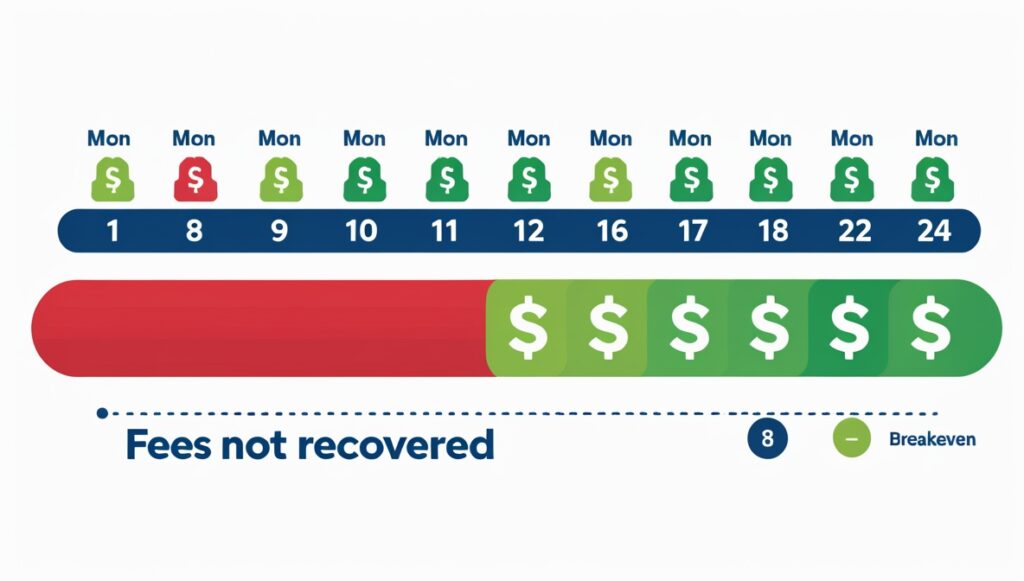
Refinancing has costs. Those costs may be lender fees, new title fees, or state charges. The Breakeven Point tells how many months it takes for monthly savings to cover those costs.
Example: If switch fees are $200 and monthly savings are $25:
$200 / $25 = 8 months.
If you plan to sell the car in 5 months, do not refinance. If you keep it for 24 months, you will net gains.
Table: Breakeven Analysis for Refinance Fees
Use this table to estimate the months to recover your fees.
| Total Switch Fees | Monthly Savings | Months to Breakeven | 1-Year Net Profit |
|---|---|---|---|
| $100.00 | $20.00 | 5 Months | $140.00 |
| $150.00 | $35.00 | 4.3 Months | $270.00 |
| $250.00 | $25.00 | 10 Months | $50.00 |
| $0.00 (No Fee) | $40.00 | Immediate | $480.00 |
Case Study: Marcus and the “Term Extension” Trap
Marcus owes $20,000. He has 36 months left at 10.0% APR. His monthly payment is $645.34. Over 36 months, his total interest at 10 percent is $3,232.37.
Option A (Same Term, Lower Rate)
He refinances to 5.0% APR for the same 36 months. The new monthly payment is $599.42. Total interest at 5 percent over 36 months is $1,579.05. That is $1,653.32 less interest than his original loan.
Option B (Lower Rate, Longer Term)
He refinances to 5.0% APR but extends to 60 months. The new monthly payment is $377.42. Total interest over 60 months at 5 percent is $2,645.48.
Compare outcomes:
- Option A saves $46 per month and cuts total interest by $1,653.32 vs the original loan.
- Option B saves $268 per month now but increases total interest by $1,066.43 compared with Option A. Option B still results in less total interest than the original 10 percent loan, but it pushes more interest into extra months.
Marcus must choose between short-term cash flow and long-term cost. If he needs the cash now to cover bills, he may choose Option B. If his goal is to pay less overall, he should pick Option A and keep the shorter term.
When Refinancing is a Bad Idea
A lower rate is not always enough reason to refinance. There are specific situations where going through the process costs you more than it saves, or where approval is unlikely from the start. Check whether any of these apply before you apply.
You Have Negative Equity
If you owe more than the car is currently worth, most lenders will decline the application outright. The vehicle is their collateral, and a loan balance above the vehicle’s value means they cannot recover the full amount if you default. Some lenders will approve refinances up to 120 or 125% LTV for borrowers with strong credit, but beyond that the options narrow significantly.
The practical fix is a lump-sum cash payment to bring the balance below the vehicle’s value before applying. Even a few hundred dollars can shift the math enough to qualify. See the Loan Requirements page for the full LTV calculation.
You Are Near the End of the Loan
If you have 6 to 12 months of payments remaining, most of what you owe is principal, not interest. Auto loans are front-loaded with interest, meaning the early payments carry a much higher interest portion than the later ones. By the end of the loan, interest charges per payment are very small.
Refinancing at this stage resets the amortization schedule and adds fees on top. The total savings in interest rarely justify the cost and effort. Run the calculator with your actual remaining balance and months to confirm, but as a rule of thumb the closer you are to payoff the less there is to save.
Your Current Loan Has a Prepayment Penalty
Some lenders, particularly in subprime financing, include a prepayment penalty clause. This charges you a fee for paying off the loan early, which is exactly what a refinance does. The penalty can range from a flat fee to several months of interest.
Pull out your original loan contract and look for the phrase ‘prepayment penalty’ or ‘early payoff fee’ before you do anything else. If the penalty is large enough, it can eliminate the savings from a lower rate entirely. Call your lender and ask for the exact penalty amount before proceeding.
The Fees Are Too High Relative to Your Savings
Title transfer fees, state registration charges, and lender origination fees add up. In some states, title and registration costs alone can run $150 to $300. If your monthly saving is $20 and the fees total $400, you need 20 months just to break even. If you plan to sell or trade in the car before that, the refinance costs you money.
Always divide total fees by monthly savings before committing. That breakeven number is the minimum number of months you need to keep the car for the refinance to make financial sense.
You Plan to Sell or Trade In Soon
The breakeven calculation only works if you hold the car long enough to recover the upfront costs through monthly savings. If you are planning to sell or trade within the next 12 months, there is a real chance you will not reach breakeven even with a meaningful rate reduction.
Be realistic about your ownership timeline before applying. If you are already shopping for your next car, refinancing the current one is probably not worth the hard inquiry on your credit.
You Need to Remove a Cosigner and the New Lender Does Not Allow It
Some borrowers refinance specifically to remove a cosigner from the loan. That is a valid reason to refinance, but not all lenders handle it the same way. Some require the primary borrower to qualify entirely on their own from the start. Others offer a cosigner release after a set number of on-time payments on the new loan.
Confirm the cosigner policy with the new lender before submitting a full application. If removing the cosigner is the primary goal, make sure the new loan actually accomplishes that rather than just shifting the cosigner to a new agreement.
You Have GAP Insurance or a Warranty That Will Not Transfer
GAP insurance covers the difference between what you owe and what the car is worth if it is totaled or stolen. If your current loan has a positive GAP balance and you refinance, the original GAP policy may be voided or may not automatically attach to the new loan.
Contact your GAP provider before closing the refinance and confirm whether coverage continues, needs to be updated with new lender information, or requires a new policy. Extended warranties are usually tied to the vehicle rather than the loan, so those typically transfer. But confirm in writing rather than assuming.
You Are Considering a Variable Rate Product
Most auto loan refinances offer fixed rates, which means your payment stays the same for the life of the loan. Some lenders offer variable rate products with a lower initial rate that adjusts periodically based on a benchmark index.
The initial rate on a variable product can look attractive on paper, but if rates rise you could end up paying more than your original loan. Unless you are certain you will pay the loan off before the first adjustment date, a fixed rate is almost always the safer choice for a refinance.
Your Credit Score May Drop Before Funding
The rate you are quoted during pre-qualification is based on your credit score at that moment. If anything changes your score between the quote and the final funding, the lender may adjust the rate or decline the application. Common triggers include applying for other credit, missing a payment on any account, or a significant change in credit utilization.
Once you decide to refinance, avoid opening new credit accounts or making large purchases on existing cards until the new loan is funded. Even a small score drop can move you into a different rate tier.
You Have Outstanding Fees or Are at Risk of Repossession
If you have unpaid late fees, a deferred payment, or are behind on the current loan, most lenders will decline a refinance application immediately. Lenders want to see that the borrower is current and in good standing before agreeing to take over the loan.
Bring the account current first. Pay off any outstanding fees and make at least one or two on-time payments after doing so before applying. A lender seeing a recently resolved delinquency is more likely to consider the application than one seeing an active problem.
Practical Steps to Decide
Get the exact payoff amount from your current lender. Use this number in every calculation.
List all switch costs: title, registration, dealer fees, and any lender fees. Add them to the financed amount.
Run two amortizations: one for your current loan and one for the new loan. Compare total interest and monthly payment.
Find the breakeven month using the total switch cost divided by the monthly savings.
Check prepayment terms on your current note. Confirm there is no penalty.
Ask the new lender about fees and whether they will roll fees into the loan. Rolling increases the financed balance and interest.
Request a soft prequalification first to see rates without a hard inquiry.
Confirm transfer of GAP and warranty if those matter to you.
Consider term length carefully. Extending the term lowers the monthly payment but may increase the total interest.
Check cosigner rules if the loan has a cosigner you want released.
Plan for timing. If funding takes several days, note the exact payoff date so you do not get charged extra interest.
FAQs
Can I refinance twice?
Yes. But each hard inquiry can temporarily lower your score. Make sure each refinance adds value.
Does refinancing affect my credit?
Applying triggers a hard inquiry. Over time, on-time payments on a more affordable loan can boost your score.
Will I lose GAP or warranty coverage?
Not automatically. Ask your providers. Some policies do not transfer. Confirm in writing.
Can I refinance with a cosigner?
Yes. But the new lender sets cosigner rules. If you want a cosigner removed, check the new loan terms first.
What happens if I roll fees into the loan?
Rolling fees increase the financed balance. You pay interest on those fees. That raises the total cost.
What if the lender denies me because I owe too much?
You may need to pay down negative equity first. Or wait until your loan balance drops or your credit improves.
How do I check for prepayment penalties?
Look at your original loan contract. Call the lender and request a payoff quote that shows any penalty.
Will the monthly autopay date change?
Yes. The new lender will set the payment date. You can usually change it after funding.