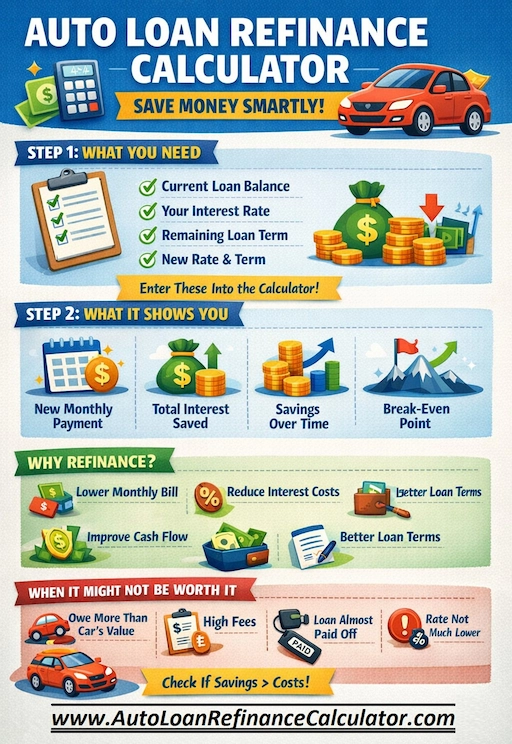
When you refinance a car loan, you swap one loan for another with new terms. This can lower your monthly payment or cut the total interest you pay.
For the main calculator and all resources, visit Auto Loan Refinance Calculator
The Core Objective: Monthly Savings vs. Total Interest
Choose your goal before you start. Most borrowers want one of two results: lower monthly cash flow or less total interest.
Lower monthly payments free up cash now. They often come from lengthening the loan term. That helps a household budget. But a longer term usually raises total interest cost.
Lowering the interest rate while keeping the same term reduces both the monthly payment and total interest. That is the best outcome when you can get it.
The 1% Rule of Thumb
A common test is the 1% Rule. If you can cut your APR by at least 1.0% to 1.5%, the refinance likely pays for itself.
Smaller drops, such as 0.25% or 0.50%, may only save a few dollars per month. Those small savings often do not cover fees or the time and paperwork. Wait or improve your credit score if the drop is tiny.
Credit Score Migration and Rate Tiers
Your credit score strongly affects the APR. Lenders use rate tiers. Move up a tier, and you can save a lot.
- Deep Subprime (<580): Typically, rates above 15-20%.
- Subprime (580–619): Often 10 to 15 percent.
- Near Prime (620–659): Often 6 to 10 percent.
- Prime (660–719): Rates usually drop 6 percent.
- Super Prime (720+): Lowest market rates.
If you bought the car with a 600 score and now have 680, you likely moved from Subprime to Prime. That shift can cut your rate significantly.
The Breakeven Calculation
Refinancing has costs. Those costs may be lender fees, new title fees, or state charges. The Breakeven Point tells how many months it takes for monthly savings to cover those costs.
Example: If switch fees are $200 and monthly savings are $25:
$200 / $25 = 8 months.
If you plan to sell the car in 5 months, do not refinance. If you keep it for 24 months, you will net gains.
Table: Breakeven Analysis for Refinance Fees
Use this table to estimate the months to recover your fees.
| Total Switch Fees | Monthly Savings | Months to Breakeven | 1-Year Net Profit |
|---|---|---|---|
| $100.00 | $20.00 | 5 Months | $140.00 |
| $150.00 | $35.00 | 4.3 Months | $270.00 |
| $250.00 | $25.00 | 10 Months | $50.00 |
| $0.00 (No Fee) | $40.00 | Immediate | $480.00 |
Case Study: Marcus and the “Term Extension” Trap
Marcus owes $20,000. He has 36 months left at 10.0% APR. His monthly payment is $645.34. Over 36 months, his total interest at 10 percent is $3,232.37.
Option A (Same Term, Lower Rate)
He refinances to 5.0% APR for the same 36 months. The new monthly payment is $599.42. Total interest at 5 percent over 36 months is $1,579.05. That is $1,653.32 less interest than his original loan.
Option B (Lower Rate, Longer Term)
He refinances to 5.0% APR but extends to 60 months. The new monthly payment is $377.42. Total interest over 60 months at 5 percent is $2,645.48.
Compare outcomes:
- Option A saves $46 per month and cuts total interest by $1,653.32 vs the original loan.
- Option B saves $268 per month now but increases total interest by $1,066.43 compared with Option A. Option B still results in less total interest than the original 10 percent loan, but it pushes more interest into extra months.
Marcus must choose between short-term cash flow and long-term cost. If he needs the cash now to cover bills, he may choose Option B. If his goal is to pay less overall, he should pick Option A and keep the shorter term.
When Refinancing is a Bad Idea
Avoid refinancing when:
- If you owe more than the car is worth, most lenders will not refinance without a large cash payment.
- You have only 6 to 12 months left. Late-stage loans pay very little interest each month.
- Your current loan has a prepayment penalty. Check the contract. Some lenders charge for early payoff.
- Switch costs are high. If title, registration, or processing fees are large, savings shrink fast.
- You plan to sell or trade soon. If you replace the car within a year, you may not reach breakeven.
- You need a cosigner release. Some refinance loans do not allow easy cosigner removal.
- You have a gap or an extended warranty that does not transfer. Losing coverage can raise out-of-pocket risk.
- You moved into a variable-rate product by mistake. A variable rate can rise later and undo early savings.
- Your credit score could drop during the process. New credit checks and timing can change your eligibility.
- You have high unpaid fees or repossession risk. Lenders may deny refinancing in these cases.
Practical Steps to Decide
Get the exact payoff amount from your current lender. Use this number in every calculation.
List all switch costs: title, registration, dealer fees, and any lender fees. Add them to the financed amount.
Run two amortizations: one for your current loan and one for the new loan. Compare total interest and monthly payment.
Find the breakeven month using the total switch cost divided by the monthly savings.
Check prepayment terms on your current note. Confirm there is no penalty.
Ask the new lender about fees and whether they will roll fees into the loan. Rolling increases the financed balance and interest.
Request a soft prequalification first to see rates without a hard inquiry.
Confirm transfer of GAP and warranty if those matter to you.
Consider term length carefully. Extending the term lowers the monthly payment but may increase the total interest.
Check cosigner rules if the loan has a cosigner you want released.
Plan for timing. If funding takes several days, note the exact payoff date so you do not get charged extra interest.
FAQs
Can I refinance twice?
Yes. But each hard inquiry can temporarily lower your score. Make sure each refinance adds value.
Does refinancing affect my credit?
Applying triggers a hard inquiry. Over time, on-time payments on a more affordable loan can boost your score.
Will I lose GAP or warranty coverage?
Not automatically. Ask your providers. Some policies do not transfer. Confirm in writing.
Can I refinance with a cosigner?
Yes. But the new lender sets cosigner rules. If you want a cosigner removed, check the new loan terms first.
What happens if I roll fees into the loan?
Rolling fees increase the financed balance. You pay interest on those fees. That raises the total cost.
What if the lender denies me because I owe too much?
You may need to pay down negative equity first. Or wait until your loan balance drops or your credit improves.
How do I check for prepayment penalties?
Look at your original loan contract. Call the lender and request a payoff quote that shows any penalty.
Will the monthly autopay date change?
Yes. The new lender will set the payment date. You can usually change it after funding.